sabato 7 aprile 2012

Siege!

Two days ago I have gone to visit my friend Gianni in order to play a battle with him.
Previously, he had said that he was preparing a "surprise" for me!!!
I was very curious about the "surprise" and I could not imagine what it was ...
This is the reason why I have been very wondered when I discovered that, instead a pitched battle, he had prepared a stretch of wall and siege machines in order to play a episode of the battle of St. John of Acri!
I have said to him that I never played Magna Acies! in a siege, but he has not been worried about this.
During the battle, the rules have proved to be flexible enough to manage the different situation.
We need only to improve a bit the existing rules concerning fight against entrenched enemies and to develop some special rule.
But the main problem was the scale: Magna Acies! has been created to play large battles, so it's not suited to simulate an almost skirmish fight around a short stretch of walls!
In order to develop the rules to play the siege of St. John, I have suggested to him to build not only a part of the walls, but the entire circuit of walls of the old city!
I know that it's not an easy task, but I'm sure that this will be a fascinating challenge for our next future.
Gianni has said that the real siege of St. John of Acri was a quite complex affair, with not only siege works and assaults against the walls, but also landings and sorties: I think that play it will be very interesting.


mercoledì 28 marzo 2012

Magna Acies! in the Medieval Age

Some days ago Gianni and me have tried to play a Medieval battle with Magna Acies! for the first time.
Forgetting for a moment the Antiquity, we have decided to explore the age of the Crusades, in particular the Third Crusade.
We have needed to develop specific "army lists" for the Crusaders and Muslims armies, and there has been a very complex email traffic between Gianni and me in the days before the fight!
The battle has been very interesting, with the Muslims trying to use in the best effective way their major agility and "firepower", while the Crusaders were attempting to deploy their infantry in order to save the knights for a final massive attack against the enemy lines.
But the Muslim mounted bowmen have been very effective, and the Christian army has suffered lots of casualties.
The final effort of the knights has proved not so effective, so the Muslims have won the battle, which has been played with 15mm figures owned by Gianni.
The game has been very pleasant and quite balanced; now we have to further develop the "army lists" and to improve the rules in order to magnify the "command and control" function over the impetuous units.
I'm sure that other medieval battles will follow in the very very next future ...

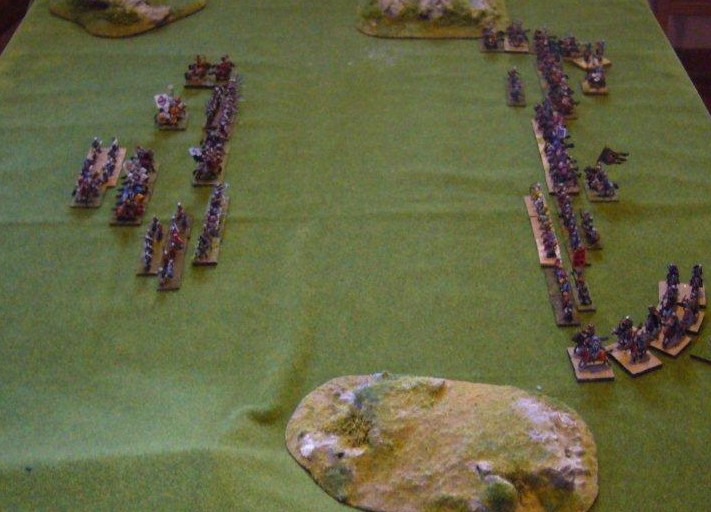
The beginning of the battle (Muslims in the right, with the mounted bowmen moving ahead from behind in column in order to outflank the Crusaders)
Muslim levies and heavy cavalry
Muslim medium infantry and mounted bowmen
Foot Templar knights
Templars and Hospitalier knights
The outcome of the battle: Muslim mounted bowmen surrounded the Christian knights

domenica 25 marzo 2012

Roman and Alamannic command groups

I'm at the last steps of my work regarding the battle of Strasbourg.
Now it's time to show you my last effort: the commanders.
As I have explained in my last post, I have had to "invent" the generals, due to the lack of specific figures of commanders related to the IV century a.D..
I have used some pieces coming from the Italeri set "Gothian cavalry" both for the Alamannic king (Cnodomar) and for Julian himself.
I have also created a Roman standard bearer carrying a "vexillum" with the portrait of the Emperor Constantius II: at the time of the battle, Julian was "caesar", and not still "emperor".
So, the following is the result of my work: take a look!

Caesar Julian with his "staff"

King Cnodomar and "staff"

Roman sub - General 1
Roman sub - General 2


Alamannic sub - General
 

martedì 6 marzo 2012

Alamannic command groups

I'm near the end of my work, so now I need command groups for the two armies at Strasbourg.
Unfortunately in the market there aren't specific models for this purpose, so I have to invent something by myself. 

Speaking of the Alamannic commanders, I have started from the usual Miniart set, but I've taken some piece also from the Italeri "Gothian cavalry" set (nr. 6138).
The latter is very well realized in terms of sculpting and moulding, but there are some important mistakes, such as the stirrups and a sort of "mix" appearance of the models, someone resembling a Gothic, someone other a Roman, someone other also a Mongol ... A strange set, but very well executed, technically speaking.
Anyway, I have changed some pose, in order to accommodate flags in the hands, then I have added crests on the helmets and cloacks to the main leaders.
Most important: I have added the thumb finger to the right hand of king Cnodomar (I hope it will not look like a revolver ...)!
The last additions are made in epossidic plaster.
About the flags, I don't know anything about the shape of an Alamannic or Gothic flag, so this is just fancy ...  


giovedì 9 febbraio 2012

Julian's light infantry and bowmen

Other small but very important additions to the Roman army at Strasbourg.
I have painted some light infantry units; in the battle line, they were deployed at the left wing of the Roman army, in front of the woods occupied by the Alamans.
All models are from Miniart.
I also painted some units of bowmen, who were deployed behind the heavy infantry first line in order to hit the incoming Alamannic hordes.
This time the most part of the models are from the relatively new Italeri set dedicated to the Late Imperial Legion (nr. 6137), a very nice set indeed.


martedì 7 febbraio 2012

Romans vs Carthaginians

A couple of days ago another test for my new improvements to the rules with Gianni.
This time the focus was on the manipular tactic, so the choice was almost mandatory: Romans against Carthaginians!
The composition of the armies was quite typical: medium iberian infantry, gallic warbands, heavy african phalanx and lots of medium and light cavalry for the Carthaginian, massive heavy legionary infantry, few medium cavalry and some light cavalry for the Roman.

Carthaginian army
Roman army


The deployment of the armies was also quite traditional: the Carthaginian general placed the Iberians and the Celts slightly forward, in order to get the first strike, and he left the phalanx just behind for the second hit; the medium cavalry was massed on the left, skirmishers and light cavalry on the right, near the small hill (Carthaginians left in following picture).
The Roman general followed the same tactical concept and placed the two lines of legionary infantry (hastati and principes) in the centre, and cavarly and skirmishers at the wings in order to face their african counterparts (Romans right in picture).


The battle began with the African cavalry charging the Roman medium cavalry, the latter heavily outnumbered.
Near the hill, the opposite skirmisher began to fight each other, while the Carthaginian light cavalry decided to move toward the opposite wing, in order to support the medium cavalry.


In the centre, the first line of the legions moved against the Iberians and the Gauls and, after a short while, the clash happened; the first contact was balanced, with the barbarian heat causing some problem to the Roman first line.


At the left wing of Roman army, the Roman cavalry was very soon disbanded and routed by the Iberian, African and Celtic cavalry.


While the Carthaginian cavalry tried to regroup after the victorous battle, in the centre the legions began to do their job: the maniples in the second line rushed in battle one by one and for the Iberian and the Celts there was no escape and they began to retreat.

 
The Carthaginian phalanx moved against the Roman lines, in order to avoid the total collapse of the centre in the hope of a quick arrival of the victorious cavarly against the back of the roman lines.


For a short while, the phalanx tried also to extend its front in order to avoid surrounding, but in the very centre the Iberians and the Celts didn't resist anymore, so the legions were able to pivot to their left and to attack the flank of the phalanx.


This was the end of the phalanx and of the battle.
Oppositely to what normally happened in the first part of the Second Punic War, here the Romans were able to break the centre of the Carthaginian army before the returning in the field of the African cavalry.
As you can see in picture, the cavarly was very near to arrive, but just a bit too late ...


Another very balanced battle, with the Romans that won but not without fear; they lost some important units (the whole cavalry and some legionary units) and the Carthaginian too was very near to win.

During the battle, the balance of the rules concerning the manipular support has been a matter of debate between Gianni and me; probably I will slightly modify the rules in order to make less effective the support of the second roman line.
But the system is working very well: now deploying an army in two lines makes sense!

venerdì 20 gennaio 2012

Late Romans vs Alamans

Two days ago, with my friend Gianni, I have played a fictional battle (15 mm.) between late Romans and Alamans with my rules "Magna Acies!".
The focus of the day was not simply to play a battle, but mainly to improve the rules in order to make worth deploying the army (expecially Roman army) in two ranks.
This is what I (the Roman) have made; instead, Gianni (the Alaman) has deployed the Alamans in massed formations, but one behind the other.
The picture below shows this, with the Romans on the left and the Alamans on the right:


The Alamannic warbands in the centre begin to push toward the legions which  face them:


The clash happens in the centre, while at the corners opposite light troops are skirmishing (left in picture) and Roman cavarly is prevented to attack due to the presence of a massive formation of Alamannic bowmen deployed before Alamannic cavalry (right in picture):


In the centre, Alamans are pushing very hard against Roman lines, and they are able to gain some important advantage breaking sometimes the Roman first line and forcing some Roman auxilia and bowmen to run away.
But the roman second line is fresh, and it can rush in battle and clash against the tired barbarians, supporting the first line, where still existing:


So, the Roman centre (legions and auxilia) is able to push back the Alamans, and the most important barbarian divison (which was fighting against legions) suddenly takes the flight:


Near the river, Roman cataphracts decide at last to charge the Alamannic archers (who run away) and to rush against Alamannic cavalry, suffering heavy casualties:


But we are at the end of the day: Alamans, after a first successful moment, are forced to gradually withdraw, loosing lots of warriors.
The protracted effort of the Roman lines has been able to guarantee Roman final victory!
This has happened when Alamannic player has lost half points of his army.


In coclusion, a very interesting and balanced battle, with a realistic and historical outcome.
After the typical, first barbarian heat, Roman discipline has been able to save the day, due to the deployment in depth of the Roman army.