mercoledì 30 luglio 2014

A "small Cannae", but with a different outcome!

Some days ago Gianni and me have fought a classical "Romans vs Carthaginians" battle, this time with my 20mm little soldiers.

Roman Army (15.500 men):
10.000 Roman and Italic Legions - Heavy infantry (10 bases in 3 divisions)
3.000 Skirmishers (6 bases, attached to the heavy infantry divisions)
2.500 Italic and Roman Medium cavalry (5 bases in 2 divisions)

Carthaginian Army (19.500 men):
4.000 African Phalanx (4 bases in 1 division)
4.000 Iberian Medium Infantry (4 bases in 1 division)
4.000 Celtic Warbands (4 bases in 1 division)
3.000 Skirmishers (6 bases, attached to Iberian and Celtic divisions)
3.000 Celtic, Iberian and African Medium cavalry (6 bases in 2 divisions)
1.500 Numidian Light Cavalry (3 bases in 1 division)


While the Roman "consul" choosed a very conventional deployment, with hastati and principes in the common central two lines and the cavarly at the wings, the dodgy Carthaginian choosed a different scheme, with Celts and Iberians in the centre and the phalanx at the rear.
I suppose that this remembers to me a certain battle fought in 216 BC ... Do you remember the same???? 

The battle starts with the predominant Celtic and Iberian cavalry charging the Italic allied cavalry at the right of the picture.
So, let's go, with the Carthaginians at the top of the picture and the Romans at the bottom:


The Celtic warbands charge the Roman infantry at the right wing, while the Carthaginian phalanx follows and the Iberians hold the ground at the left of the picture:


At the very right side of the Roman army, the Iberian and Celtic cavalry clashes against the outnumbered Italic allied cavalry: 


At the very left side of the Roman army, the Numidian light cavalry begins to shoot against the side of the Roman cavalry ...


... while the Carthaginian an Celtic cavalry waits until Roman cavalry has taken enough losses before charging:


At the centre, Celtic and Iberian infantry are approaching the Roman legions; skirmishers will start to shoot very soon for both sides:


At the rear of the Carthaginian army, the phalanx begins its move to storm the side of the legions:


After the shooting of the skirmishers, the melee begins: Roman and Italic legions against Iberians and Celts: 


At the very right, the Italic cavalry begins to take heavy losses from the enemy cavalry and retreats:


The situation after few game turns: Iberian and Celtic infantry retrats under the pressure of the legions, while the Carthaginian phalanx moves toward the right side of the Roman infantry; the Roman cavalry at the wings retreats or takes shoots:


This is an important stage of the battle: Iberian infantry routs and collapse under the strike of the Roman and Italic legions:


At the very right, the Italic cavalry takes the flight, while the Celtic and Iberian cavalry follows up until the end of the battlefield:


The situation: the Roman infantry is winning, while the Roman cavalry is loosing (as usual...):


Having defeated the Iberians, the central Roman legions are free to pivot and to strike the side of the surviving Celts, who are fighting against another legion on the front:


This is the right time: at the very left of the battlefield, African and Celtic cavalry charges against the Roman cavalry, which has taken many casualties from the shooting of the Numidians. 
Roman cavalry flees, but the winners are under the shooting of the Roman skirmishers of the legion which is coming back after the victory against the Iberians:


The phalanx follows its side move ... 


... and then pivots, facing the side of the Italic legion which is fighting against the Celts:


The last stage of the battle: the Celts are pressed from two sides by the legions, but now the phalanx is ready to fight after its long march:


The Celts collapse, and so do the Italic legion crushed by the phalanx; but for the Carthaginians it's too late: they have lost 4000 Iberians, 4000 Celts, 3000 Skirmishers, 500 Celtic cavalrymen; so 11.500 losses, more than half of the army (19.500 men).
The Romans have lost 3000 Italic legionaries, 1000 Skirmishers and 2500 cavalrymen, so 6.500 losses out of an army of 15.500. 


So, different to Cannae, the Roman is the winner.
Why?
Probably mainly because, different to Cannae, the phalanx was just one, while at Cannae it was splitted in two halves on both sides, and because the move of the phalanx has been too slow.
The Iberian infantry (4000 medium infantry and 2000 skirmishers) has had to face 7000 Roman legionaries and 2000 skirmishers, so the task has been a bit too challenging for them ...
The screen of Iberians and Celts was quite weak, so the phalanx should have been a bit faster.
This is the reason why some scholars say that, at Cannae, Hannibal acted like "a clock"!
Thank you for your interest!

lunedì 19 maggio 2014

Naoniscon 2014

Alcune immagini da Naoniscon 2014.
Edizione forse un po' sottotono: meno espositori e un po' meno pubblico.
Ma sempre un bellissimo evento, colorato e poliedrico tra fumetti, giochi da tavolo, wargame, e un po' di radiocomando.
Spettacolo nello spettacolo i moltissimi cosplayers, anche se alcune ragazzine hanno offerto panorami piacevoli a vedersi, ma forse un po' troppo ammiccanti, sia per il contesto, sia per l'età.
Buon divertimento con le foto:

Uno dei tre padiglioni di Naoniscon che hanno ospitato l'evento
"Capitano da mar!", navale rinascimentale


"Armati" nella Guerra dei 100 anni


"Song of blades and heroes", skirmish fantasy

Guerra d'indipendenza americana


Napoleonico (scusate l'approssimazione ...)

"Fire & fury" sulla Guerra di secessione


Tavoli di "Flames of war"

"Magna Acies!" sulle Guerre Puniche


 Altre immagini da NAONISCON 2014:


Ci vediamo alla prossima edizione ...

mercoledì 23 aprile 2014

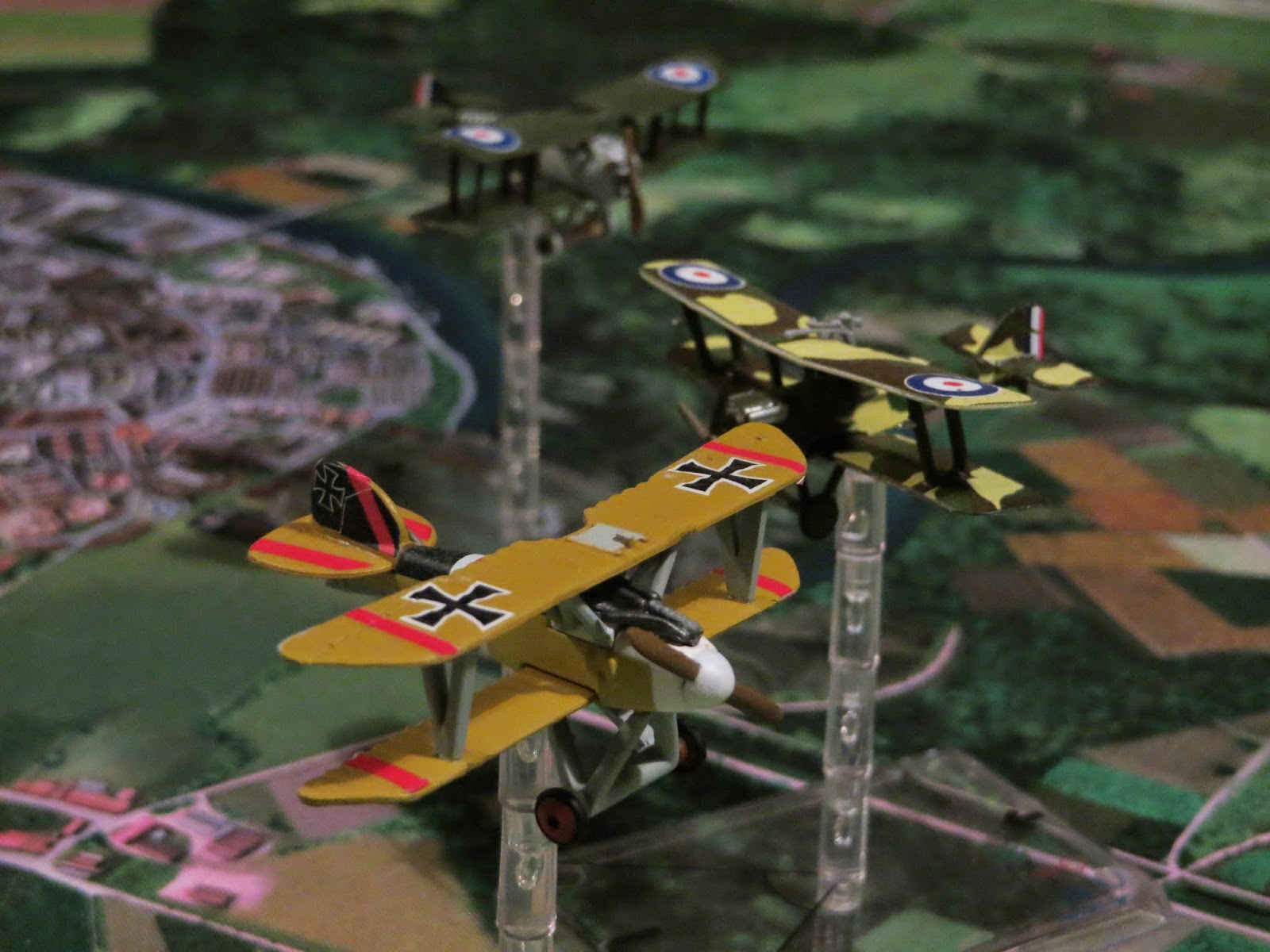
Ali di tela e motori borbottanti: una serata con "Wings of Glory"

In tema di giochi ad ambientazione "aerea", dopo le molte vorticose battaglie stellari tra astrocaccia con "X-Wing", qualche sera fa abbiamo optato per un gradito ritorno all'antico e per ritmi più lenti: dopo molto tempo abbiamo ripreso in mano i vecchi biplani di "Wings of Glory".


Con i bei modelli tedeschi e inglesi e con i dettagliati tappeti di gioco ufficiali l'appagamento per gli occhi è stato davvero assicurato, e l'esperienza di gioco è stata divertente e rilassante, anche se volutamente semplice in quanto abbiamo utilizzato poco più delle regole di base.


Ma cosa si può dire in un confronto tra "X-Wing" e "Wings of Glory"?
I giochi sono concettualmente simili, ma alcuni particolari importanti li differenziano nettamente.
In alcuni casi tali differenze saranno dovute alla più recente progettazionme del gioco "fantascientifico" rispetto al suo fratello "storico", ma forse non è così per tutto: alcune peculiarità sono senz'altro volute e testimoniano la diversa filosofia dei due giochi, che poi riflette la estrema diversità del modello di volo che si vuole riprodurre.


La prima differenza, e quella che forse più balza all'occhio, è relativa alla "progettazione" del movimento.
In entrambi i giochi la mossa da far compiere alla propria "macchina volante" viene decisa da entrambi i giocatori in anticipo, cioè senza possibilità di variarla una volta conosciuta la mossa dell'avversario, ma le differenze finiscono qui.
In "X-Wing" i giocatori scelgono una singola mossa tra quelle disponibili sulla ghiera scorrevole, poi muovono, infine eventualmente sparano; quindi scelgono un'altra mossa e così via.
In "Wings of Glory" i giocatori scelgono tre mosse da quelle disponibili nel proprio mazzo di carte, poi muovono per tre volte alternativamente e alternativamente sparano; finite le tre mosse, ne scelgono altre tre, e così via.
Al di là delle differenze "meccaniche" (ghiera anzichè carte), la differenza sostanziale tra i due sistemi sta nel fatto che in "X-Wing" il "botta e risposta" tra mossa e contromossa avviene dopo una mossa sola, in "Wings of Glory" può avvenire dopo tre mosse.
Questa può sembrare una distinzione da poco, ma in realtà è la chiave di interpretazione delle due filosofie di gioco.
Un caccia spaziale risponde alle nuove situazioni in pochi millisecondi, un biplano della prima guerra mondiale quando imposta una certa manovra ci mette del tempo a cambiare tattica di fonte a un evento imprevisto.
Il turno di gioco singolo di "X-Wing" simula forse un secondo in tempo reale, il turno di gioco di "Wing of Glory" simula un lasso di tempo molto più esteso: senza addentrarci troppo in stime, almeno qualche secondo per ogni "carta movimento".
Da un punto di vista del divertimento, io credo che l'immediatezza "meccanica" (ghiera girevole anzichè mazzo di carte) e ludica (mossa A - mossa B - tiro B - tiro A) di "X-Wing" sia più appagante rispetto al modello di gioco di "Wing of Glory", in cui ciascun giocatore è vincolato a scegliere tre mosse (scelta che a volte necessita anche di un po' di tempo) e a non poterle più mutare in ragione delle scelte dell'avversario.
Ma, al di là del fatto che il gioco "fantascientifico" è più nuovo, c'è una ragione per non aver applicato lo stesso sistema di gioco al più vecchio "Wings of Glory"? Gli autori non ci avevano pensato o c'è dell'altro?
Io penso che gli autori abbiano fatto, a suo tempo, una scelta precisa.
A ben guardare, infatti, anche le carte di "Wing of Glory" avrebbero potuto prestarsi a un "botta e risposta" immediato stile "X-Wing": bastava che le regole indicassero di scegliere una sola carta per volta anzichè tre e le differenze tra i due sistemi di gioco sarebbero pressochè annullate.
Ma, come dicevo prima, questi vecchi biplani sarebbero stati forse troppo maneggevoli: tra pensiero del pilota e azione dell'aereo doveva passare un bel pò di tempo, quindi le mosse andavano "anticipate".
La scelta di tre carte anzichè una riflette, probabilmente, proprio questo.


Le altre differenze hanno conseguenze di minor rilievo sul gioco rispetto a quanto detto finora.
E' il caso del sistema di risoluzione dei combattimenti.
In "Wings of Glory" non ci sono dadi: se il bersaglio è a tiro, pesca automaticamente carte danno, le quali hanno un valore da 0 a, mi pare, 4; con questo sistema, semplice ma efficacissimo, si eliminano i dadi ma si lascia ugualmente all'alea la conseguenza della raffica che si spara: può andare a vuoto (danno 0) o può fare molti danni (danno 4), per non parlare dei danni speciali previsti su alcune carte.
Il sistema è semplice e veloce, ma ha un limite: non c'è differenza relativa tra i due velivoli; le differenze sono lasciate solo al differente movimento (virate più strette o più larghe, velocità più alta o più bassa, ecc.) e alla robustezza della struttura, che consente di accusare più o meno danni prima di essere abbattuti.
In "X-Wing" è diverso: le differenze tra due "astrocaccia" sono dovute al differente movimento, alla differente robustezza della struttura, ma anche alle capacità offensive e difensive, dato che i qui i dadi d'attacco e di difesa si usano.
I dadi simulano quelle differenze che vanno oltre la capacità di manovra e la capacità di incassare colpi prima di essere abbattuti: simulano la "capacità di fuoco" (cioè il volume di fuoco che il mezzo è in grado di esprimere) e i "mezzi di difesa passiva" di cui il bersaglio dispone (corazzature, sistemi antiarma ecc.).
In questo caso, la differenza in termini di giocabilità va a favore di "Wings of Glory", in cui il sistema di risoluzione dei combattimenti è più veloce, ma la maggiore complessità di "X-Wing" è giustificata?
Anche in questo caso direi che la risposta è sì.
Per quanto ne so della I Guerra Mondiale, la struttura dei velivoli era simile per tutti (legno e tela), così come la potenza di fuoco delle mitragliatrici di bordo: quello che variava era la capacità dell'aereo di incassare colpi.
Cosa ben diversa il duello tra "astrocaccia": possiamo pensare a mezzi armati più o meno pesantemente, o corazzati in modo più o meno massiccio, o più o meno dotati di sistemi antiarma.
Anche in questo caso, quindi, pur con tutte le cautele del caso, possiamo dire che la differenza tra i due sistemi di gioco ha una sua plausibile giustificazione.


In conclusione, qual'è meglio?
Entrambi hanno il loro fascino, dovuto in gran parte ai bei modelli e alle ambientazioni, ma anche alle differenti filosofie di gioco di cui abbiamo poc'anzi delineato i tratti salienti.
Per non fare il solito diplomatico "cerchiobottista", dirò che, a mio gusto, preferisco il "botta e risposta" immediato di "X-Wing", che conferisce maggiore dinamismo al turno di gioco e obbliga i "piloti" a continue scelte.